
Labels promise more than formulas deliver. "How to choose men's bar soap with natural ingredients?" Judge the formula, the process and the paperwork, not the wording on the front panel. The sections below take the five most common wrong assumptions in turn and give you the check that replaces each one.
Natural men's bar soap is a solid cleansing bar whose ingredient list is mostly saponified plant oils and butters, plus botanicals, scent and colorants. Because "natural" has no single legal definition in most markets, you verify it through the INCI list, the process and supporting documents.
"What makes a men's bar soap natural?" The label rarely tells you
Natural men's bar soap earns the word through its ingredient declaration, not through a leaf graphic or a claim on the carton. Most markets leave "natural" undefined for cosmetics, which means two suppliers can use the same word for very different formulas. Your spec sheet has to carry the real definition. Some buyers adopt an industry guideline such as ISO 16128 as a reference for natural and organic origin indices, but a supplier is not bound to it unless you write it into the brief.
Read the INCI list, not the front panel
INCI stands for International Nomenclature of Cosmetic Ingredients, the standard naming system used on cosmetic ingredient declarations. Ingredients are listed in descending order of concentration, down to about 1%; below that, order can be free. In a soap, saponified oils usually appear as sodium salts, for example Sodium Olivate, Sodium Cocoate, Sodium Shea Butterate or Sodium Palmate. Glycerin, botanical powders, essential oils and colorants follow.
Ask what comes first. If a "natural" bar leads with synthetic surfactants or lists fragrance as a bare "Parfum" with no further detail, the front panel and the formula disagree. A synthetic detergent bar is a legitimate product, but it is a different product. Also check that the INCI names match the supplier's formula sheet, word for word.
Ask which product lines the natural claim covers
A supplier may describe its ingredients as natural in general. That does not tell you whether your formula, with its colorant, fragrance and preservative-free or preserved base, meets the same description. Ask for confirmation per formula, in writing, and ask what the supplier means by the word. A claim that holds for a plain olive-oil bar may not hold for a charcoal bar with a fragrance oil blend.
Separate "natural" from "organic" and "vegan"
These are three different claims. "Organic" needs a matching certificate from a recognized scheme. "Vegan" and "cruelty-free" also need documentation if you print them as certified. A bar can contain no animal ingredients and still lack the paperwork to say so on pack. Goat milk or tallow-based bars obviously fail a vegan claim. Decide which terms you want on the label before the formula is fixed, because documents are far easier to arrange at the start than after packaging is printed.
Misconception 1: Men's soap is just women's soap with a darker scent
The usual belief is that a men's line is a re-scent and a new box. In practice the format drives most of the difference. Men's bars tend to be larger, harder, with a denser lather and a heavier scent profile, and they are often used on body, hands and sometimes the face. Each of those choices changes the formula and the cost.
| Parameter | Typical men's bar | Typical women's bar |
|---|---|---|
| Bar weight | Often larger, roughly 100-150 g | Often smaller, roughly 70-100 g |
| Hardness | Firmer, slower wear in shower | Softer or creamier acceptable |
| Lather | Dense, stable | Creamy, lighter |
| Scent direction | Woody, citrus, herbal, spice | Floral, fruity, sweet |
| Exfoliant level | Often coarser texture | Often finer or none |
Treat the table as a starting brief, not a rule; these are market tendencies and your own line can break them. The point is that each row is a decision you make before sampling.
Bar weight, hardness and lather
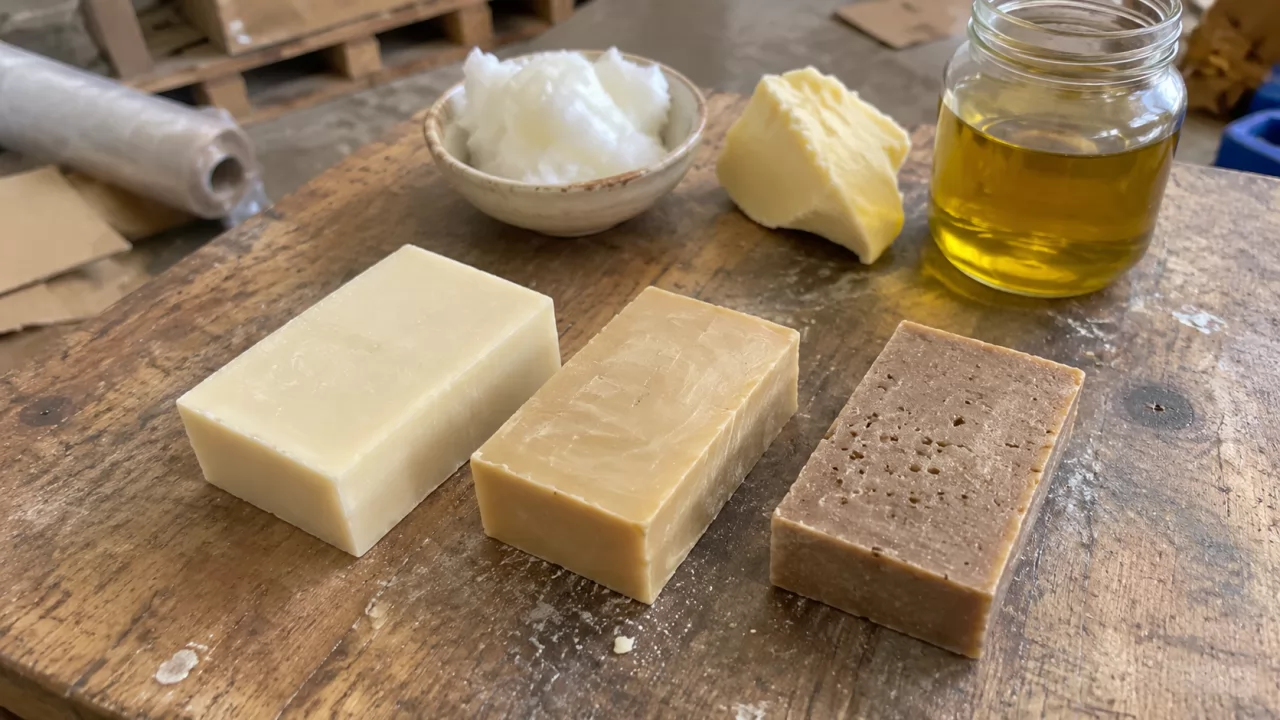
Hardness in cold process soap comes mainly from the oil blend and the cure. Coconut oil and palm-derived oils give hardness and lather; olive oil gives mildness and a slower, silkier feel; shea and cocoa butter add firmness and a creamy finish. Too much coconut oil lathers well but can feel drying. Too little makes a bar that turns soft in a wet dish. Ask the supplier for a sample that has finished its cure, because an uncured bar feels softer and behaves differently from the one you will ship.
Scent and essential oil load
Essential oil soap for men usually leans on cedarwood, tea tree, peppermint, eucalyptus, bergamot or lavender. Essential oils are fragrance materials, and some can irritate skin at higher loads; certain citrus oils also carry phototoxicity limits. Suppliers work to dosage guidance, often based on IFRA (International Fragrance Association) standards, and these limits vary by oil and product type. Ask for the supplier's maximum use level for each oil and whether allergen declarations will appear on the label. A strong scent is a commercial choice, not a quality marker. Scent also fades in cure and on the shelf, which matters for Misconception 5.
Misconception 2: Handmade means inconsistent, and automated means weaker
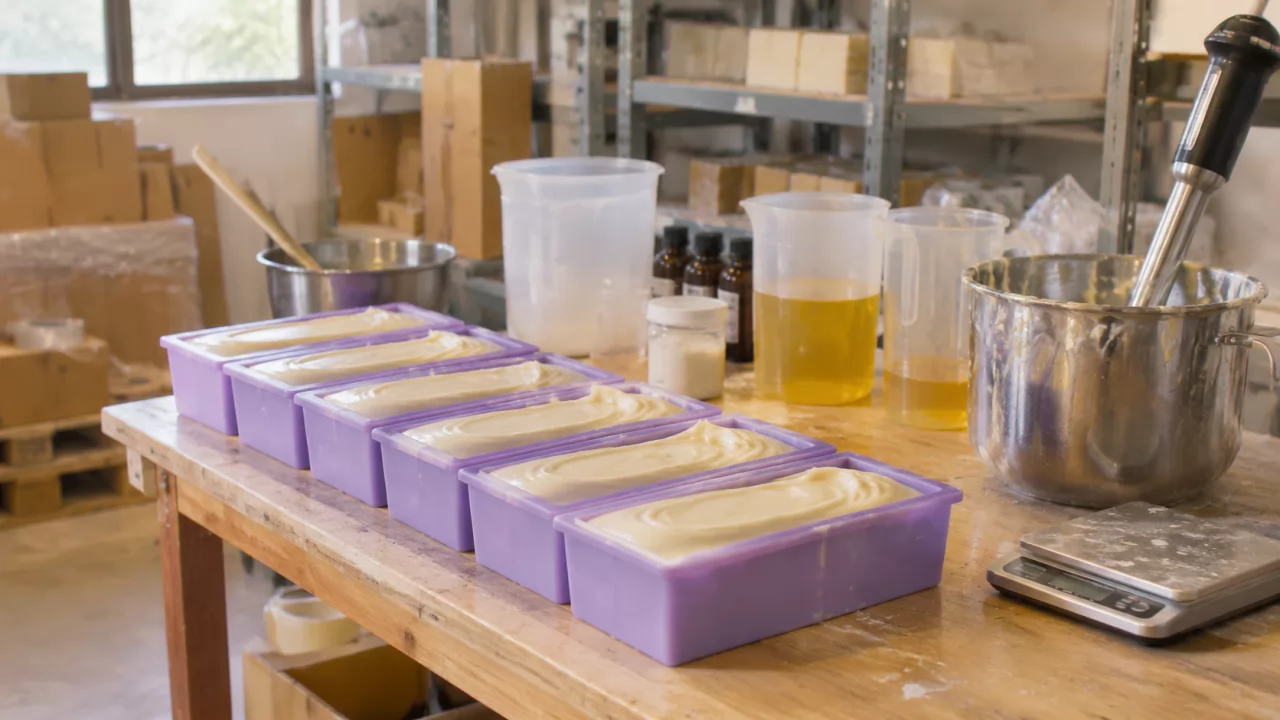
Many buyers assume handmade soap varies bar to bar and that a production line makes a lesser product. Neither follows. Consistency comes from controlled weights, fixed temperatures, timed mixing and batch records, not from whether a person or a machine moves the mold. Cold process soap for men can be made on automated lines that dose oils and lye by weight and cut and stamp bars mechanically. What stays "handmade" is the method: saponification in the mold with glycerin retained, followed by cure.
| Criterion | Cold process | Hot process | Melt and pour |
|---|---|---|---|
| Method | Saponify in mold at lower heat | Cook paste, then mold | Remelt ready-made base |
| Cure time | Typically several weeks | Shorter, often usable sooner | Little or none |
| Appearance | Smooth, clean edges | More rustic texture | Clear or opaque, uniform |
| Scent retention | Moderate; some oils fade | Heat can reduce delicate notes | Depends on base and oil |
| Cost drivers | Cure space, time | Labor, handling | Base price, additives |
No process wins on every row. Cold process suits a clean, uniform bar and a formula-led story; melt and pour suits fast launches and detailed shapes, but you buy a base rather than control saponification. Cure time sits inside your lead time, so ask how many bars are held in cure at any one time and what happens to a rejected batch. That tells you more than the word "handmade."
Misconception 3: More botanicals and actives mean a better soap
Long additive lists look natural and sell well on shelf, but each addition changes the bar. Activated charcoal darkens color and can stain washcloths. Clays add slip and a matte look, and they can make a bar feel gritty if overused. Oatmeal and ground coffee add visible texture and mild scrub, though large particles can clog drains and scratch if coarse. Turmeric colors strongly and can leave a yellow tint on light towels. Essential oils, covered earlier, add scent but also add sensitivity risk.
Describe additives by what they do to the bar: color, texture, scent. Do not write that they detoxify, clear, brighten or repair anything. Result claims need evidence, and in several markets they push a soap into drug or medical territory. A soap cleanses; leave it there.
When you decide how to choose between formula options, a few criteria do most of the work:
- Check the INCI order and whether the first oils match the hardness you want.
- Check the additive's particle size and whether it suits face or body use.
- Check color stability over cure and on the shelf.
- Check the essential oil load against supplier guidance.
- Check that each additive is confirmed as natural for that formula.
Rule of thumb: add an ingredient only if you can name what it does to the bar and prove it is in the formula.
Misconception 4: A certificate logo on the page proves the compliance you need
A logo shows a standard exists. It does not show that the product in your carton meets the rules where you sell it. Factory-level standards, such as GMP and ISO 22716 (Good Manufacturing Practices for cosmetics), describe how a site is run: hygiene, records, traceability, controls. Product-level compliance is separate. It covers the full INCI, a cosmetic product safety assessment where required (for example in the EU and UK), label content, responsible-person or notification steps, and any rules on claims.
Ask for the document, not the picture: a certificate with issue and expiry dates, the issuing body, and the site it covers. Check the scope, since a certificate may cover one facility or one product type. Where a site names FDA on its pages, ask whether that means facility registration or something else; the FDA does not approve or certify cosmetics, so wording on your own label needs care. Poleview, for one, lists GMP 211, GMPC, ISO 22716, FDA and SMETA among its standards, and any buyer should still ask to see the documents behind such a list for the intended market.
No supplier can promise that a product meets a specific country's rules without that market's review. Confirm requirements for your destination first, then match the formula and label to them.
Misconception 5: A sample that works means the bulk order will match
A good sample proves the formula can be made. It does not prove the next thousand bars will match. Color and scent drift between batches when raw materials, oil lots or cure conditions change, and a hand-finished sample is often better than the first production run. Protect yourself with a pre-production sample made on the production setup, approved in writing, and a retained sample kept by both sides for comparison.
| Stage | What happens | Approximate time |
|---|---|---|
| Brief | Format, scent, additives, market | Days |
| Sample | Formula and look approved | Usually 1-2 weeks |
| Artwork and packaging | Logo, box, carton marks | Overlaps sampling |
| Production and cure | Batch made, cured, packed | About 40 days for OEM/ODM |
| Inspection and shipping | Check, then FOB, CIF or air | Varies by route |
Lead times are approximate and depend on order size, packaging and cure. Only the OEM/ODM figure above comes from supplier data; treat the sample stage as a typical range. Ask the supplier to confirm each stage against your own order.
Checklist: Specifying a private label men's soap before you send an RFQ
A private label men's soap manufacturer can quote faster and more accurately when the brief is complete. Use this before you write.
- Define the bar format: weight, shape, and shower or hand use.
- Request the full INCI for each formula, in order.
- Write a scent brief with note families and a maximum intensity.
- List every additive and its intended effect on color or texture.
- Confirm packaging, carton marks and any special container.
- Name the documents you need for your destination market.
- Ask which tests the supplier can provide, such as stability or microbial reports.
- State MOQ per color or style and the volume you expect to reorder.
Each item removes one round of back-and-forth, and the last one affects price per bar.
FAQ
What ingredients should I look for in men's natural soap?
Look for saponified oils such as Sodium Olivate, Sodium Cocoate and Sodium Shea Butterate, plus glycerin. Question any long fragrance blend, unnamed colorants and vague "natural extracts" with no INCI names.
Can I use "hypoallergenic" or "dermatologist tested" on a natural soap?
No, not without test reports that support the exact wording. A natural formula does not make either claim valid on its own.
Is cold process or hot process better for men's handmade soap?
Neither wins outright. Cold process gives a smoother bar and needs a longer cure; hot process can be ready sooner but looks more rustic, and heat can reduce delicate scents.
What does a private label men's soap manufacturer need from me to start?
Usually a brief covering format, scent direction, additives, target market and expected order volume, plus your logo and packaging details.
Next step: Send your brief and request a sample
Write down the bar format, scent direction and destination market, then ask for a finished-cure sample to test against your brief. Our team can check the INCI and documents against that brief.